

Teardown 2026: Meet Climatron
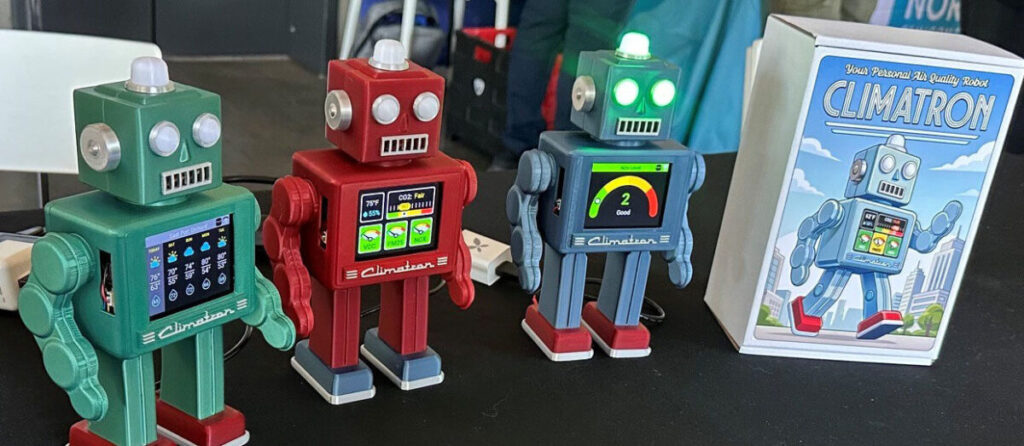
Teardown 2026: Meet Climatron!
This is the first time I’m blogging about the Climatron project, though it’s something I’ve been collaborating on with two friends since earlier this year. Last summer, we attended Teardown 2025 in Portland together, an annual conference for hardware engineers, artists and hobbyists, and we all came away inspired by the sheer creativity and positive energy on the floor. Pretty much from the moment we got back, we knew we wanted to build something together to potentially share at the 2026 show.
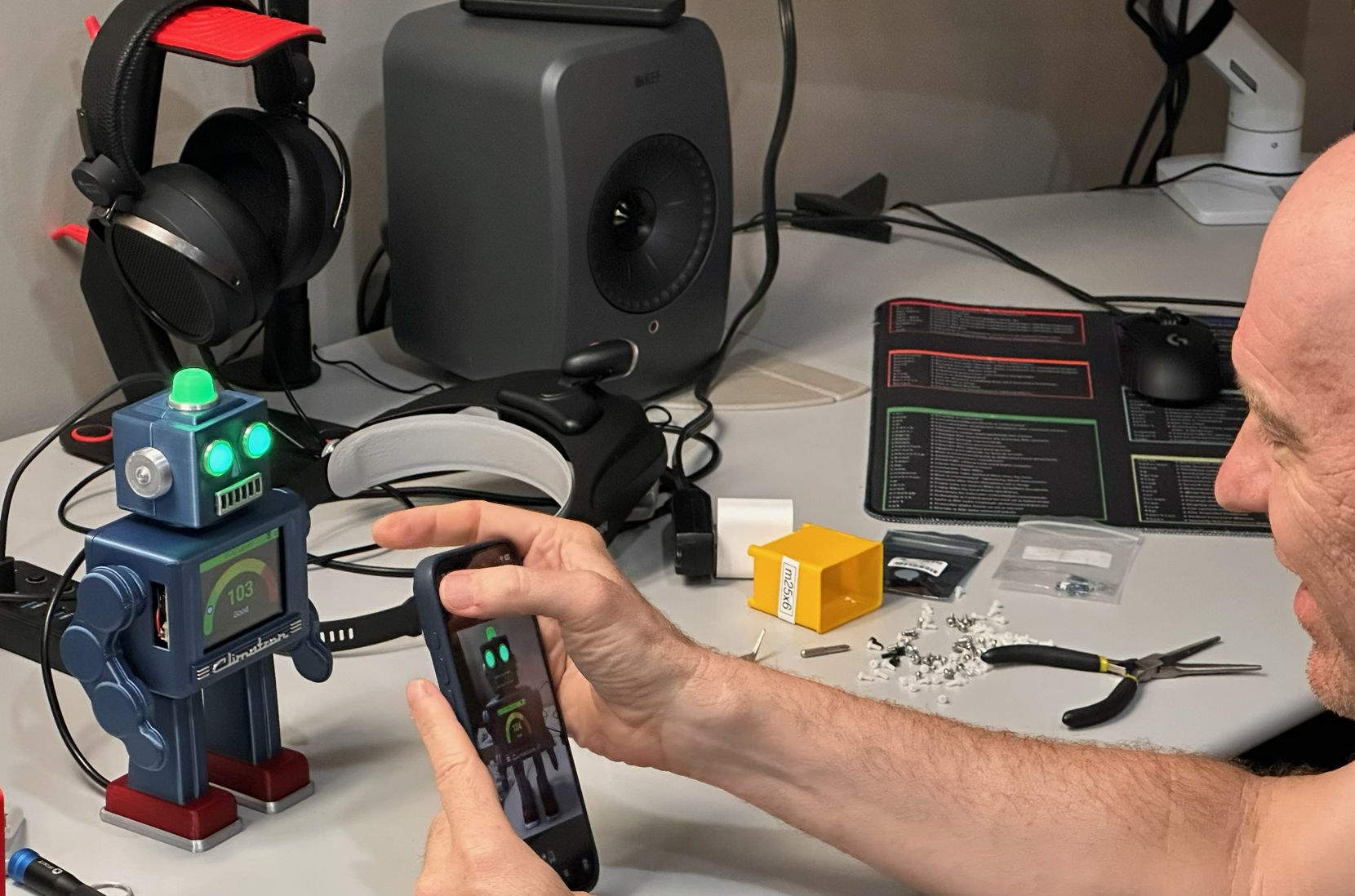
Last year my maker pals Eric and David started noodling on a compact air quality monitor built around Sensirion’s SEN66, an awesome new sensor capable of tracking up to nine environmental parameters, including temperature, CO₂, particulates, and VOCs (volatile organic compounds). While I gladly deferred to their expertise in hardware and software engineering, I spent some cycles thinking about the interaction model and UI layer to support a touchscreen interface for such a device. Around the same time, Eric was exploring ways to imbue modern tech with a bit more warmth and character, and at some point he shared a quick sketch of an air quality monitor embedded in the chassis of a toy robot. Given my casual obsession with vintage tin toys, that was all it took to convince me to jump in and help turn this concept into something real.

Figma mockups of key screens for the touch display. We were going for a modern look with subtle callbacks to the mid-century aesthetic.
For the interface, we wanted to keep navigation frictionless; in lieu of complex menu gymnastics, we used a simple hub-and-spoke model anchored by a single “Home” screen that summarizes all key indicators at a glance, letting you intuitively tap in and out of detailed sub-screens. Stylistically, while the overall UI is clean and modern, I wanted the Home screen to pay subtle homage to Climatron’s mid-century aesthetic; specifically, the three analog-style gauges across the bottom (VOC, PM2.5, and NOX) are a stylistic nod to the vibrant, printed lithography and mechanical dials seen on vintage tin toy robots.
Producing Climatron’s chassis turned into my first “original” 3D printing project. For me the timing was perfect: my wife had gifted me a Bambu A1 Mini for Christmas, and I was eager to move beyond downloading and printing pre-made models from MakerWorld and learn the full workflow from scratch: modeling in Blender, slicing in Bambu Studio, and iteratively printing and tweaking the 3D printed results. It took quite a few reprints to balance aesthetics with real constraints: providing proper airflow for the sensor, housing the ESP32 and touchscreen, and routing the wiring and LEDs. Nailing down the tolerances for a modular, durable form factor was a big learning curve, but seeing it all come together was quite satisfying. Best of all, I now have a solid foundation of the Blender to 3D printing workflow to carry over to other projects.
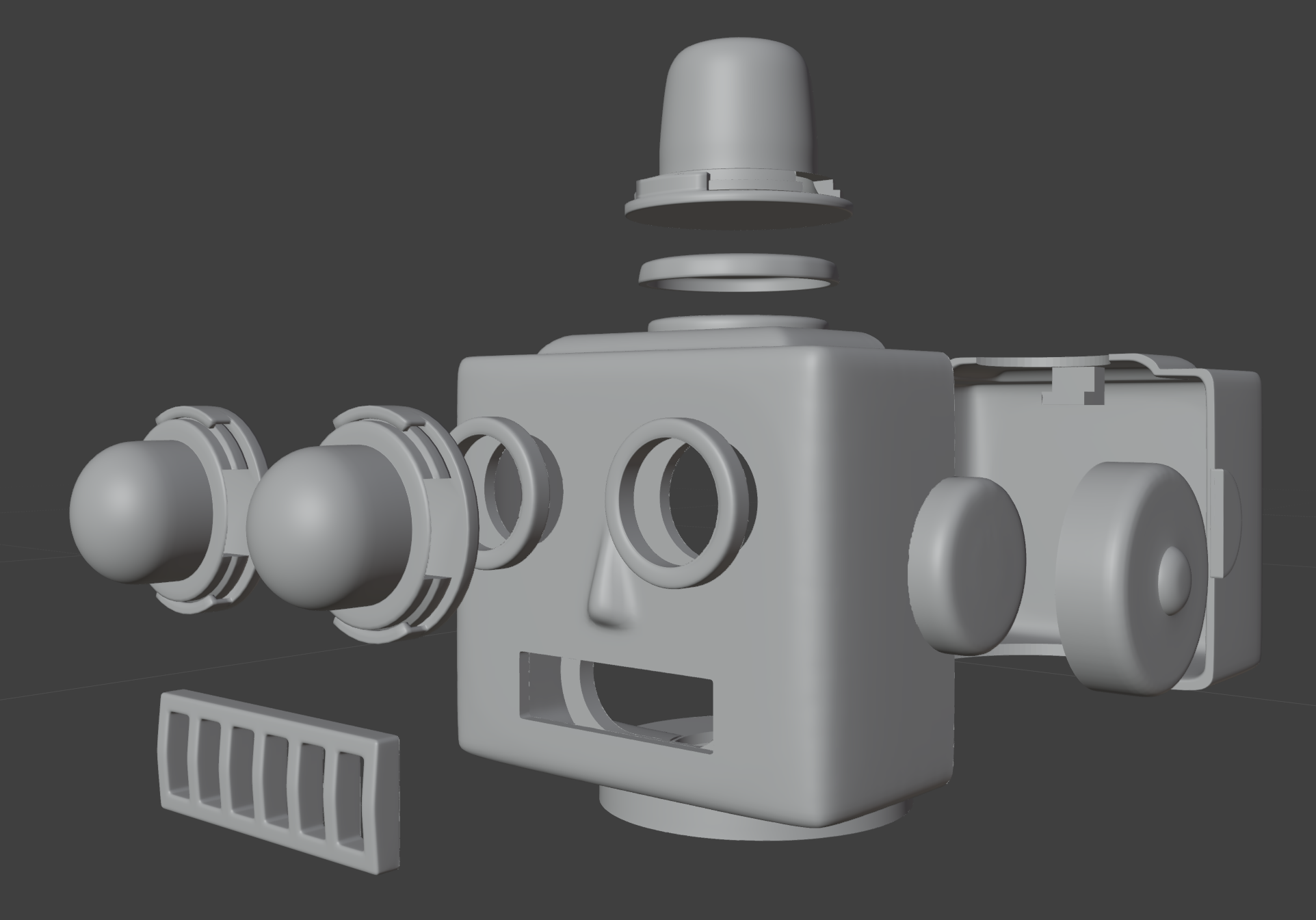
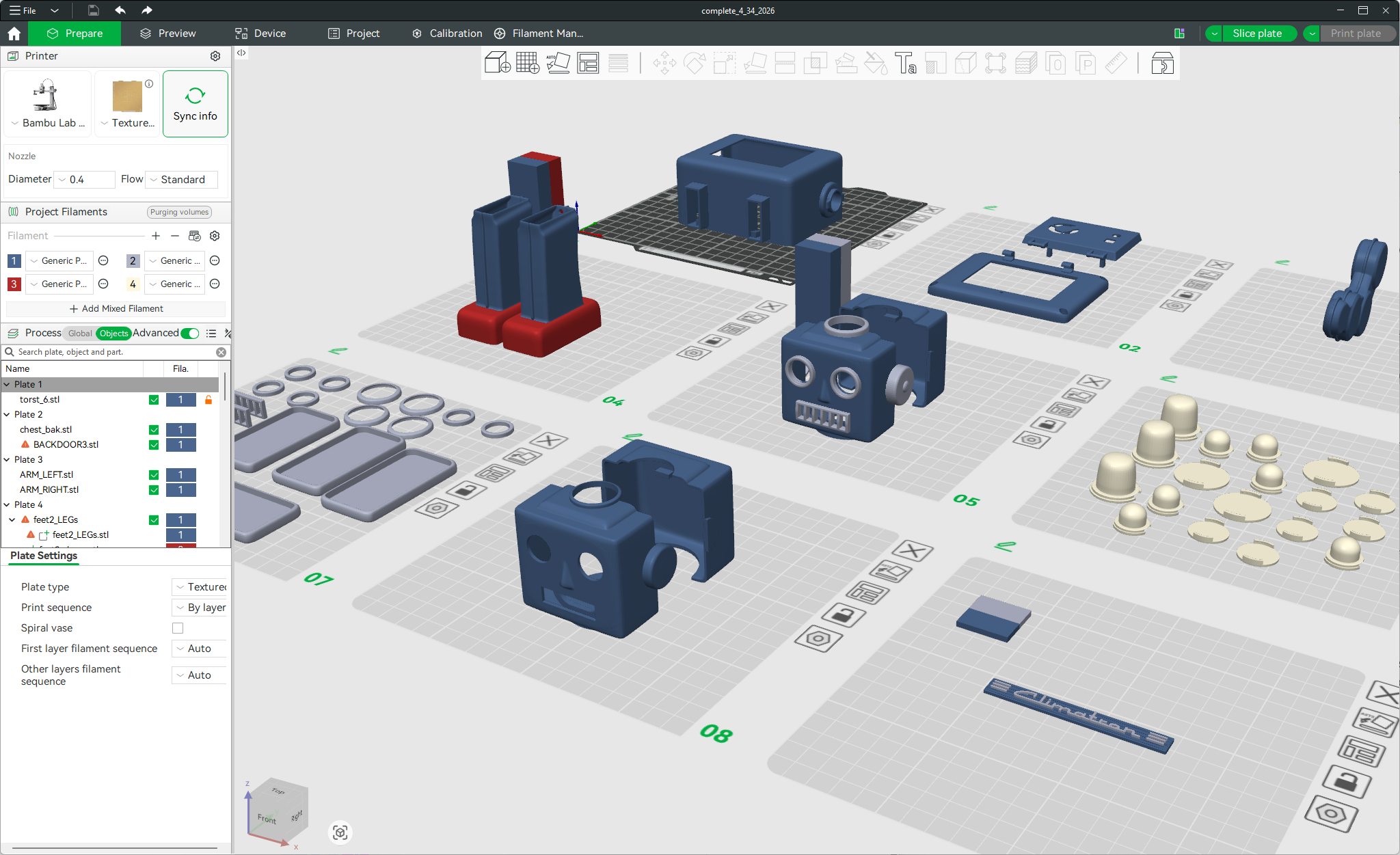
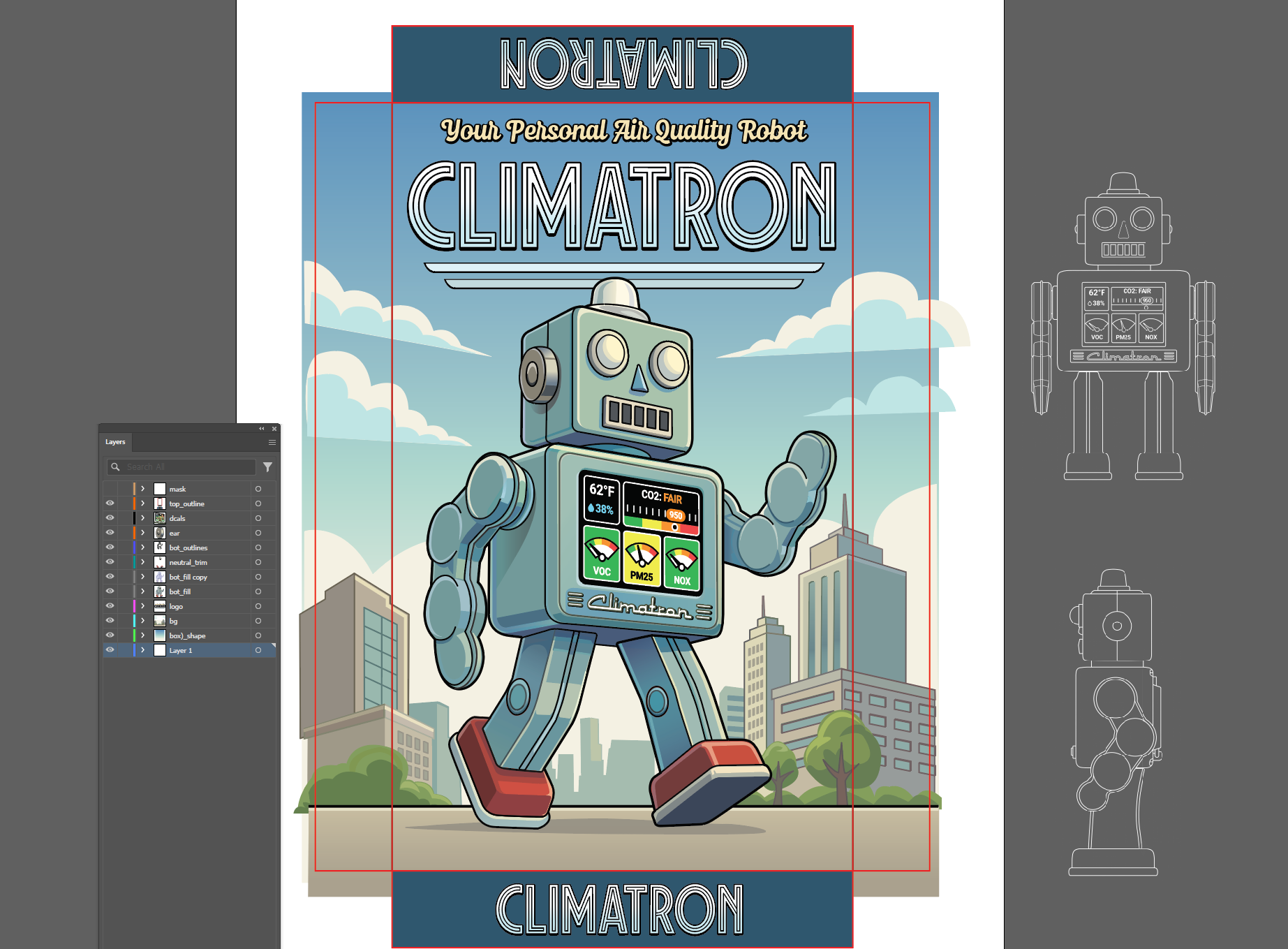
Left to right: head components in Blender; 3D printed parts in Bambu Studio; final draft of box design; first run of “feature complete” Climatron.
While I honed in on the design aspects, David and Eric brought Climatron to life under the hood. Among other things, Eric nailed the hardware chassis, power setup, ESP32 integration, and the head-mounted LED array that shifts color based on atmospheric health. On the software side, David masterfully impemented all the UI and architected a clean, scalable data pipeline; Climatron can push live metrics to ThingSpeak, InfluxDB, MQTT, and Home Assistant, making it easy to monitor air quality remotely or trigger automations like turning on an exhaust fan for example.
At Teardown, our original plan was simply to walk the floor with our Climatrons in tow, and socialize the project during casual 1-on-1 conversations. Serendipity struck though when a show organizer let us claim an empty exhibitor table left by a no-show. That unexpected spot opening up gave us a home base to demo the units, leading to many engaging conversations with makers from every discipline, which in turn inspired us with a raft of new ideas to consider for future iterations.
Bringing Climatron from initial ideas to a live demo on the exhibitor floor was even more fun and intrinsically rewarding than I imagined it could be. Looking back, I realized we were living out a core part of my post-retirement dream: building fun, challenging, tangible things alongside great friends, purely for the joy of it. Here’s to the next version of Climatron, and our next wave of unwritten new projects yet to be made.